Why Most AI Blog Tools Sound Nothing Like You (And How to Fix It)
You've tried AI writing tools. You pasted in your YouTube link, hit generate, and got back something that technically covers the same topic as your video — but sounds nothing like you. The phrasing is generic. The personality is gone. It reads like every other AI-generated article on the internet.
This is the dirty secret of most video-to-blog tools: they're fast, but they strip out the one thing that makes your content valuable — your voice.
Here's why this happens, why it matters, and what to do about it.
🤖 The Generic AI Problem
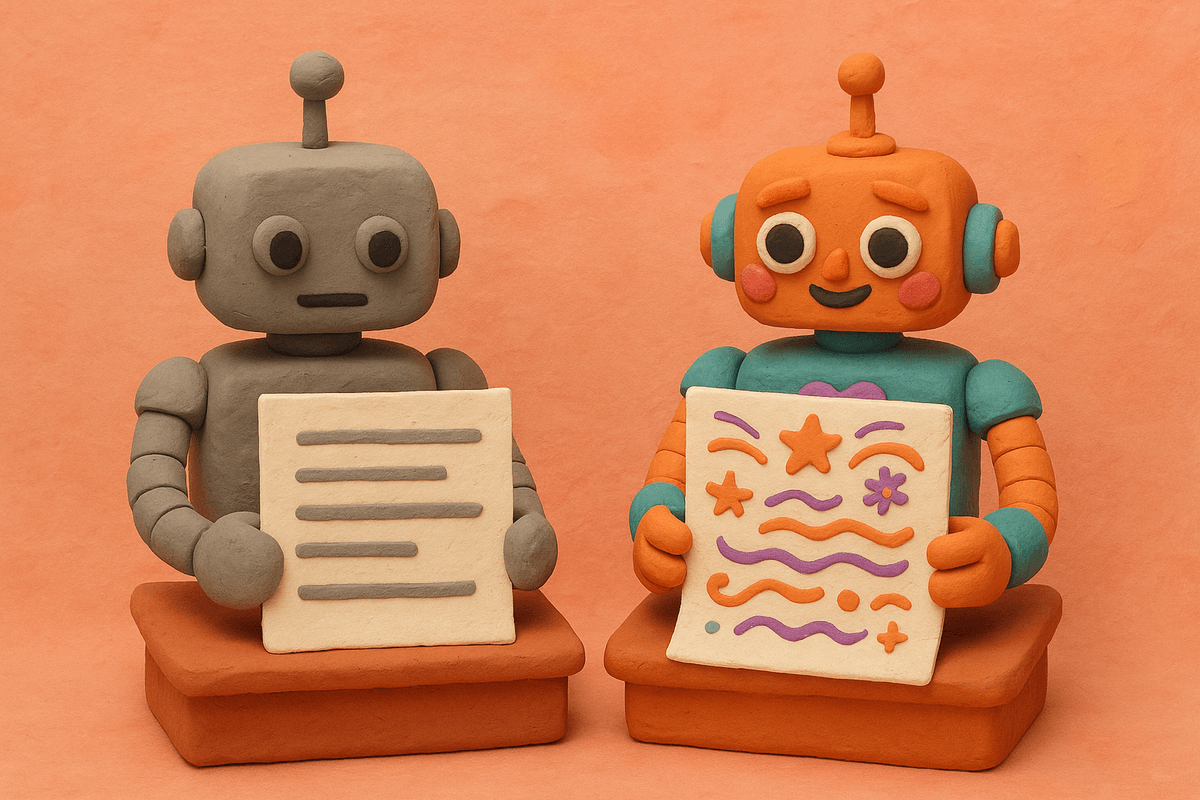
Most AI writing tools work by taking your transcript and essentially asking a language model to "rewrite this as a blog post." The model does what it's trained to do: it produces fluent, grammatically correct, well-structured content. But it writes in its own default voice — not yours.
You've seen the telltale signs:
Overly formal language where you'd naturally be casual. "It is imperative to consider" instead of "you need to think about."
Generic filler phrases that no human would actually use. "In today's digital landscape" or "it's worth noting that" — the hallmarks of AI-generated content.
Loss of specific details that made your original content valuable. The AI smooths over your specific experiences, examples, and opinions in favour of generic advice that could apply to anyone.
Uniform tone across every piece. Whether you're passionate, frustrated, excited, or reflective in your video, the AI output sounds the same — pleasant, neutral, forgettable.
The result is content that's technically correct but personally empty. And your audience can tell.
👤 Why Voice Matters More Than You Think
Your voice is your competitive advantage. It's the reason people watch your videos instead of someone else's videos on the same topic. It's the specific way you explain things, the examples you use, the opinions you hold, the personality you bring.
When AI strips that voice out, it's removing the only thing that differentiates your content from everyone else's. A generic blog post about "how to start a YouTube channel" competes against millions of other generic articles. A blog post that sounds like you — with your specific perspective and experience — is unique.
Readers notice. If someone discovers your blog through Google and then watches one of your videos, the voice should feel consistent. If the blog sounds like a corporate whitepaper and your videos sound like a friend giving advice, the disconnect erodes trust.
Google notices. Search engines are increasingly sophisticated at evaluating content quality. Google's guidelines specifically mention E-E-A-T: Experience, Expertise, Authoritativeness, and Trustworthiness. Content that reads like generic AI output scores poorly on all four counts compared to content that demonstrates genuine personal experience and perspective.
Conversion suffers. If you're using blog content to drive sign-ups, sales, or YouTube subscribers, generic content converts poorly. People take action when they feel a connection with the person behind the content. AI-stripped voice kills that connection.
🔍 Why Most Tools Get It Wrong
The fundamental problem is architectural. Most video-to-blog tools follow a simple two-step process:
- Transcribe the video
- Ask AI to rewrite the transcript as a blog post
Step 2 is where voice dies. A single prompt asking AI to "rewrite this transcript as a blog post" gives the model almost no information about your voice, style, or personality. The model defaults to its own generic writing voice because that's all it has to work with.
Some tools try to fix this with tone settings — "casual," "professional," "friendly." But these are surface-level adjustments. Selecting "casual" doesn't make AI sound like you. It makes AI sound like a generic casual writer. Your voice is much more nuanced than a dropdown menu can capture.
Others let you provide "writing samples" or custom instructions. This helps, but it puts the burden on you to articulate what makes your writing voice unique — something most people can't easily do.
✅ What Voice Preservation Actually Looks Like
Genuine voice preservation requires a fundamentally different approach. Instead of treating the conversion as a simple rewrite, it needs to be a multi-step pipeline where each step preserves different aspects of your original content:
Content analysis — understanding what your video actually says, not just what words appear in the transcript. This means identifying your key arguments, the specific examples you use, and the structure of your reasoning.
Insight extraction — pulling out the genuinely valuable parts of your content. Not every sentence in a 15-minute video belongs in a blog post. The valuable insights, practical tips, and unique perspectives need to be identified and prioritised.
Voice matching — generating written content that mirrors how you naturally communicate. This goes beyond tone. It includes your vocabulary, your sentence structure, your tendency toward directness or elaboration, and the types of examples you naturally reach for.
Format adaptation — reshaping content for readers without flattening your personality. The structure changes (spoken to written), but the voice stays.
This is the approach Content2Blog was built around. Instead of a simple "rewrite this transcript," it runs a multi-step pipeline where each stage focuses on preserving a different dimension of your original content. The result is a blog post that sounds like you actually wrote it — because the insights, perspective, and voice are genuinely yours.
🛠️ How to Evaluate Any AI Blog Tool
If you're shopping for a video-to-blog tool, here's how to test whether it actually preserves your voice:
Generate a post from a video where you have a strong opinion. If the output hedges or neutralises your position, the tool is overriding your voice.
Compare the output to how you'd naturally write. Read it aloud. Does it sound like you? Or does it sound like "an AI writing assistant"?
Look for your specific examples and details. If you mentioned a particular experience, tool, or result in your video, it should appear in the blog post. Generic tools often replace your specific details with vague generalisations.
Check for AI clichés. Phrases like "in the ever-evolving world of," "it's important to note that," or "at the end of the day" are dead giveaways. If the tool produces these, it's not preserving your voice — it's replacing it.
Try multiple videos. The output from different videos should sound like the same person (you) while covering different topics. If every post sounds identical regardless of the source video, the tool has a voice problem.
🎯 The Bottom Line
AI can be an incredible tool for content creation — but only if it preserves what makes your content valuable in the first place. Speed means nothing if the output is generic. Volume means nothing if every post sounds the same.
The right tool should feel like having a skilled editor who knows your voice, not a random copywriter who's never met you. The content should pass the simplest test: would you be comfortable publishing this under your name, without editing, and having your audience read it?
If the answer is no, the tool is prioritising speed over quality. And in a world where Google and readers are both getting better at spotting generic AI content, quality is the only sustainable strategy.